

It has been three days — not even three full days — since I shared the private preview of Part One and Part Two of my upcoming book. And already, the book has started doing what books do once they leave your hands, even partially: it responds.
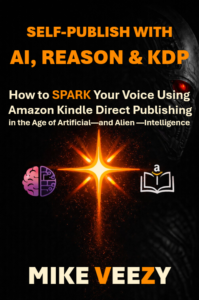
Part One and Part Two took me a year and a half. That sounds long for a book about AI — especially one that is explicit about how AI was used. But life happened. December 2024 was my internal deadline, the moment I wanted to have a pre-release ready. Christmas came and went. The pre-order window closed before it opened. And somewhere around that same period, something happened that still resists a clean label — not for me, not for those closest to me, and not even among specialists who approach it from different angles. I’ll leave it unnamed here. Labels simplify; they also flatten.
Three days ago, the preview went out quietly. Personally. To a small group of people from my network — people I know, not abstractions. One response arrived exactly the way I half-expected it to: structured, AI-assisted, transparent about prompts and process. Effort matters. Transparency matters. And feedback, in any form, matters.
One observation landed immediately. The critique pointed out that even in the preface and introduction, I introduce several self-made concepts and frameworks — ideas that might compete for attention early on. The point was fair. I do introduce my own language. Deliberately. The preface itself is an ironic demonstration of what I called GLIDE (Generative Learning-Induced Drift Effect). It doesn’t apologize for that; it performs it. Still, the feedback made me pause — not because it was wrong, but because it touched something deeper.
Do people even read prefaces?
I usually skim them. I only return once the book has earned my trust. Maybe that’s fine. Maybe that, too, is part of the design.
When the Roles Reverse with a Ghost
Here is what surprised me.
While Part One and Part Two took 1½ year, Part Three nearly completed itself in 1½ day. Eight chapters. A radically different pace. Not because I rushed. Not because I cared less. But because the role changed.
In Part One, I was the authority. Decades of experience. Frameworks I had lived with long before AI entered the room. Talks I had given. Patterns I had refined over time. AI functioned as a sparring partner — a ghostwriter in service of my voice.
In Part Two, I walked the campaign. Step by step. Upload. Preview. Approve. Publish. Execution creates its own authority.
Part Three is different. It deals with the aftermath: dashboards, metrics, ego traps, and systems that respond to behavior rather than intention. And here is the uncomfortable truth — I had not lived that part yet. So I let AI step forward as provisional author, drawing from broader patterns and generalized behavior, while I moved into the role of editor. Heavy editing. Friction. Judgment. Responsibility.
That shift changed everything. Speed included — but speed was not the goal. Accuracy was.
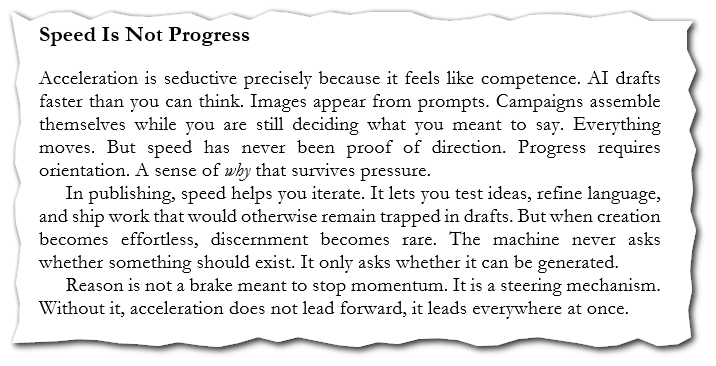
This also reframes disclosure. I will not label this a “GenAI book,” because it isn’t. The burden of proof is on me, and I’m fine with that. I will disclose AI-chats. I will document evolution. I will show how the models changed — from earlier versions to newer ones — and how my own way of working changed alongside them. Features that did not exist when I started now shape the workflow. That belongs in the book. Or in an update. Which implies something else entirely: a changelog.
I am not writing about this process anymore. I am inside it.
Size, Value, and the Strange Math of Worth
The manuscript will land under a hundred pages. That number messes with my head more than it should. Value bias runs deep. Thicker feels worth more, even though some of the most influential ideas I’ve ever encountered took less than a page to explain. Like Barbara Minto’s pyramid changed how I think forever. I spent barely a page on it. That does not diminish its impact.
Maybe compact is not cheap. Maybe it is precise.
So, here we are. The first feedback arrived — not as a verdict, but as a return signal. A loop closed.
That is when it became clear: this text itself is already part of the book’s early aftermath. Dictated in a car. Captured as a voice memo. Passing through the same tools described in its pages. The book is no longer just a product in progress. It has become a (re)source— a node that feeds back into itself.
Three days in, one and a half years behind me, and the work has started working.
Which feels like exactly the right moment to stop explaining — and let it continue.
What's on your mind?