

Every time you craft a business pitch, proposal, or project plan, you’re doing more than sharing ideas—you’re scripting a vision of the future. In essence, you’re telling a story that hasn’t happened yet. Sound familiar? That’s the core of science fiction.
Your proposals, project plans, and advisory reports are essentially futuristic narratives about ideas yet to be realized, wrapped in a product, service, or solution offering. Wait a minute…
Science fiction and sales?
Yuck. Could anyone possibly blend a worse clashing combination?
Well yes—maybe with politics or religion thrown in tongue-in-cheek. But don’t worry, this article is strictly about consultative management skills that will likely fascinate you. And yes, this intro was intentionally packed with highly contaminated terms:
Selling your innovative idea to clients with science fiction stories.
Let’s clarify these “poisoned” phrases and their antidotes—before we bring in Steven Spielberg. We’ll start by redefining key terms, then draw lessons from Spielberg’s storytelling style, and finally connect it all to your own consulting practice.
Purifying the Lingo: Sales ≠ Your Success = Successful Clients ≠ Prospects
The word ‘sales’ carries a negative connotation for many potential customers—or their so-called ‘prospects.’ And for good reason. For decades, certain salespeople have viewed business decision-makers as “opportunities to sell more stuff,” with little or no regard for actual customer needs. From this point on, let’s agree to discard such defiled lingo.
It’s not about selling. It’s about helping clients succeed by realizing their goals.
A ‘goal’ is a strategic idea—set by your client. Anyone who wants your help, whether they’re an existing relationship or a new contact, deserves your focus. Make no distinction—make the difference. Be the consultant your client wants: a trusted advisor and ethical partner who helps achieve their vision.
Let’s learn how to turn fairy tales—those unrealistic, wishful pitches—into authentic, captivating stories inspired by the master of science fiction: Steven Spielberg.
Sure, you could argue that Stanley Kubrick (2001: A Space Odyssey), George Lucas (Star Wars), Ridley Scott (Alien), The Wachowskis (The Matrix), or Christopher Nolan (Inception) delivered more “serious” Sci-Fi masterpieces. But Spielberg offers something they don’t quite match.
Critical Success Factor: Manage Expectations from the Get-Go
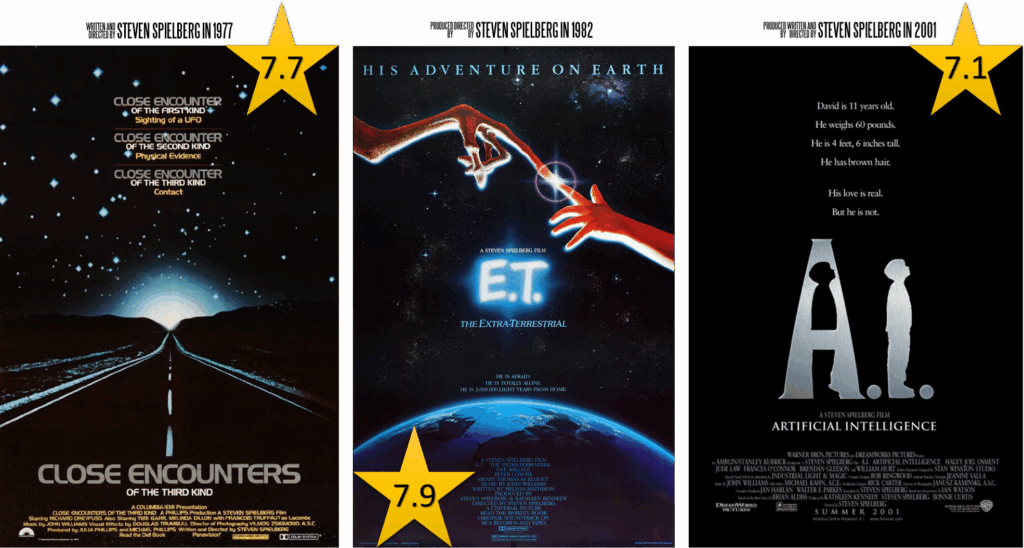
Spielberg films set clear expectations—often long before the opening credits roll. Just like a successful consultant, he frames the experience with precision from the outset, ensuring the audience knows what journey they’re about to embark on. In business, this translates to framing your proposals or strategies clearly from the beginning—so your clients understand the problem, the path forward, and the potential outcome. Just look at his expressive titles and explanatory subtitles on movie posters.
Let’s explore three key takeaways from Spielberg’s unique brand of storyselling.
Third Kind: Promise What You’ll Deliver to Prevent Disappointing UFOs
Take Spielberg’s first Sci-Fi film: Close Encounters of the Third Kind (1977). The movie poster explains everything:
- First Kind: Sighting of a UFO
- Second Kind: Physical Evidence
- Third Kind: Contact
So no surprises—viewers knew exactly what they were in for. If someone opted not to see the movie due to disinterest in UFOs, Spielberg might have thought:
“That’s cool—at least no one leaves disappointed.”
Why? Because it’s much harder to satisfy someone who feels their time was wasted. Money spent is refundable; time spent is not. Unless, of course, time is just a construct of the human mind—and someday science finds a way to roll it back.
So what’s the lesson?
Always promise what you will deliver. Then deliver what you’ve promised.
UFO therefore stands in our book for: Underdelivered Fake Overpromise
Second Kind: Use ET to Convert Crowds—Especially Emotional Beings from Another World
With E.T.: The Extra-Terrestrial (1982), Spielberg raised the emotional bar. The poster again made things clear: this was a story about a lonely, frightened alien 3 million light-years from home.
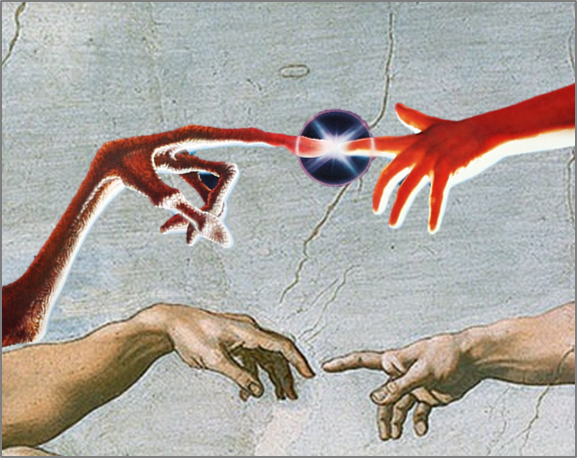
Unlike Close Encounters, E.T. also teased its audience visually, offering a glimpse of the alien’s appearance. Over 30 years later, that iconic image still lingers in our collective memory.
Spielberg achieved Emotional Telling (ET) mastery. He touched millions, including people who previously dismissed Sci-Fi as nerdy or irrelevant. He extended his audience and connected worlds—creating a cinematic universe everyone could relate to.
That’s an art form. It’s iconic. It’s memorable.
So appeal to emotion to captivate and convert your audience. But remember: emotional resonance must be combined with trust. Keep your promises.
First Kind: Beware of AI—It’s No Guarantee of Financial Success
With Artificial Intelligence (A.I., 2001), Spielberg took full creative control—writing, directing, and producing. So how did it perform?
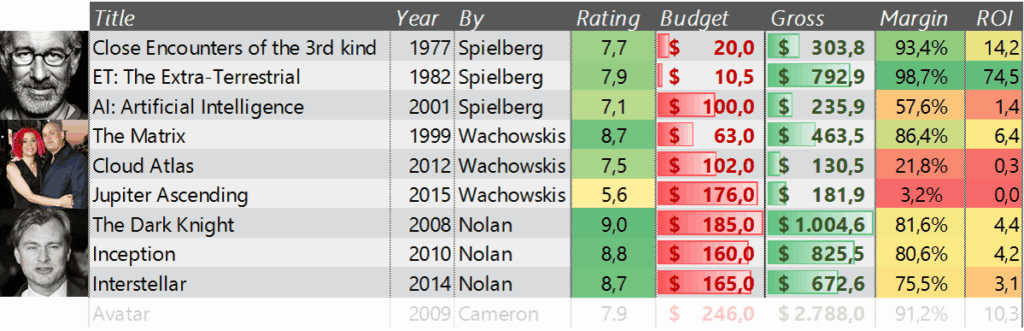
Pretty decently. It scored 7.1 on IMDb. But lower than Close Encounters (7.7) and E.T. (7.9). Ratings aside, the number that studios care most about is gross revenue.
A.I. grossed $235.9M on a $100M budget. That’s an ROI of 1.36 and a gross margin of 57.6%.
Compare that to:
- Close Encounters: $303.8M gross, with only a fifth of A.I.’s budget.
- E.T.: $792.9M gross on just a $10.5M budget. Spielberg’s most profitable Sci-Fi film to date.
Even The Matrix had a lower return on investment. This reinforces a critical insight: a well-crafted narrative—clear, resonant, and emotionally grounded—can elevate profitability beyond what flashy effects or bigger budgets alone can achieve: $463.5M gross on a $63M budget (x7.36). Meanwhile, Cloud Atlas—an ambitious Sci-Fi epic—earned $130.5M on a $103M budget (x1.27).
Sometimes, storytelling trumps spectacle. In consulting, it’s not always the flashiest presentation or the most complex solution that wins—it’s the one that resonates, that connects emotionally, and that tells a clear, believable story your client wants to be part of.
Red Pill or Blue Pill? The Choice for Consultants
🔵 The blue pill: Keep pushing uninspired offerings to disinterested prospects.
🔴 The red pill: Offer something your clients actually want to buy.

Let’s be real. Most pitches, plans, or presentations end with a simple call to action—something you, as the producer, want to happen in the near future.
Usually, that’s:
- Purchase our product/service,
- Approve the budget in my plan, or
- Implement my advised solution to your problem.
All of these are future-focused. And often, your sales team hopes the decision will be immediate—a signature that seals the deal.
But here’s the consulting truth: you don’t lead with a product.
You lead with:
- A well-articulated future action.
- Backed by logical, ideally scientific arguments.
- Delivered as a compelling story.
In that order—because the best stories, like the best strategies, unfold with clarity, logic, and impact.
Final Frame: Don’t Mimic—Be Authentic
Spielberg never tried to be Kubrick or Lucas or Nolan. He was always himself—sometimes sentimental, sometimes visionary, but always Spielberg.
Don’t mimic.
Be authentic.
Be the world’s most trusted advisor—at least in your client’s world. Think of it like becoming the go-to director for your genre. Just as audiences trust Spielberg to deliver an unforgettable cinematic experience, your clients should trust you to bring their vision to life with clarity, creativity, and consistency.
And if your world is a niche, own it like it’s your personal blockbuster.
Lights, camera… consult. Just like Spielberg promised contact with aliens, or ET phoning home, your role is to signal clearly, connect meaningfully, and deliver an unforgettable experience.
Make your consulting practice the story clients remember.
And retell.
What's on your mind?